
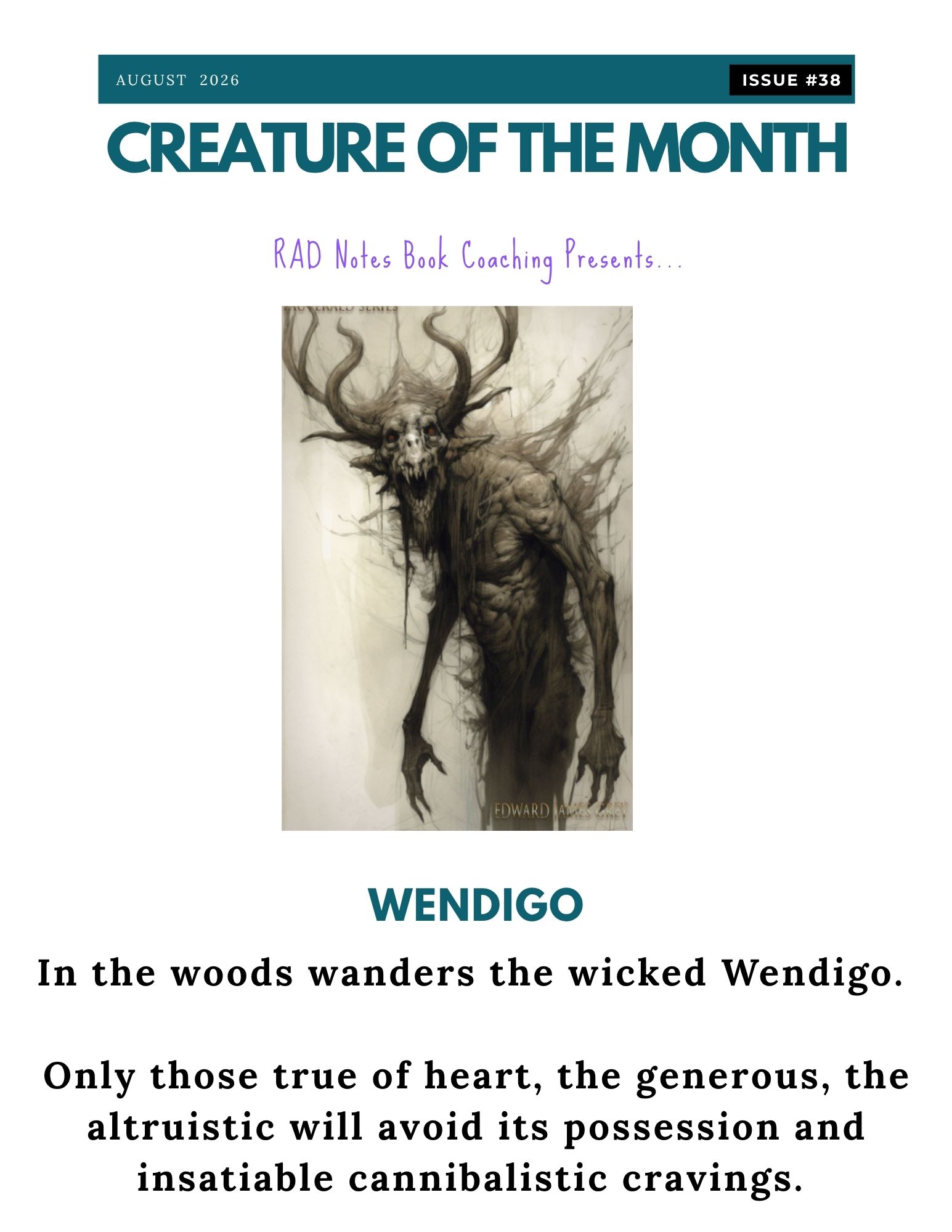

A Wendigo is a transformed human who feasts on human flesh.
The Indigenous People of Canada, specifically, the Anishinaabe, the Cree, and other Algonquin speaking people, warn us of the dangers of individual greed, selfishness, and isolation with the legend of the Wendigo.
Winter is harsh in Canada. In a time when people needed to ban together and share their resources to survive, they collaborated and fought against starvation and the cold as a community. The Wendigo attacked those that rejected help and starvation set in; on the opposite perspective, those who chose to hoard all of the resources, too, fell victim to the Wendigo.
The Wendigo is sneaky. It whispers I hushed, inaudible tones or has a high-pitched scream that echoes through the forest and drives its victim slowly insane, in a kind of reckless terror. The victim unknowingly loses track of their surroundings as the creature stalks its prey. Once in its mighty claws, the Wendigo possesses the person, making them feast on other humans.
The first written form of the Wendigo appeared in 1636 in a report by Paul Le Jeune, a French Jesuit missionary living among the Algonquin people near what is now Quebec. He described a woman who had eaten some of her tribal members. Later, in Alberta 1879, a Cree hunter named Swift Runner claimed a Wendigo possessed him, entered his dreams, and told him to eat his family. He was later convicted of murder and hanged for his crimes—which just shows that humans couldn’t blame cryptids for murder then, just as much as they can’t blame them today. Shucks!
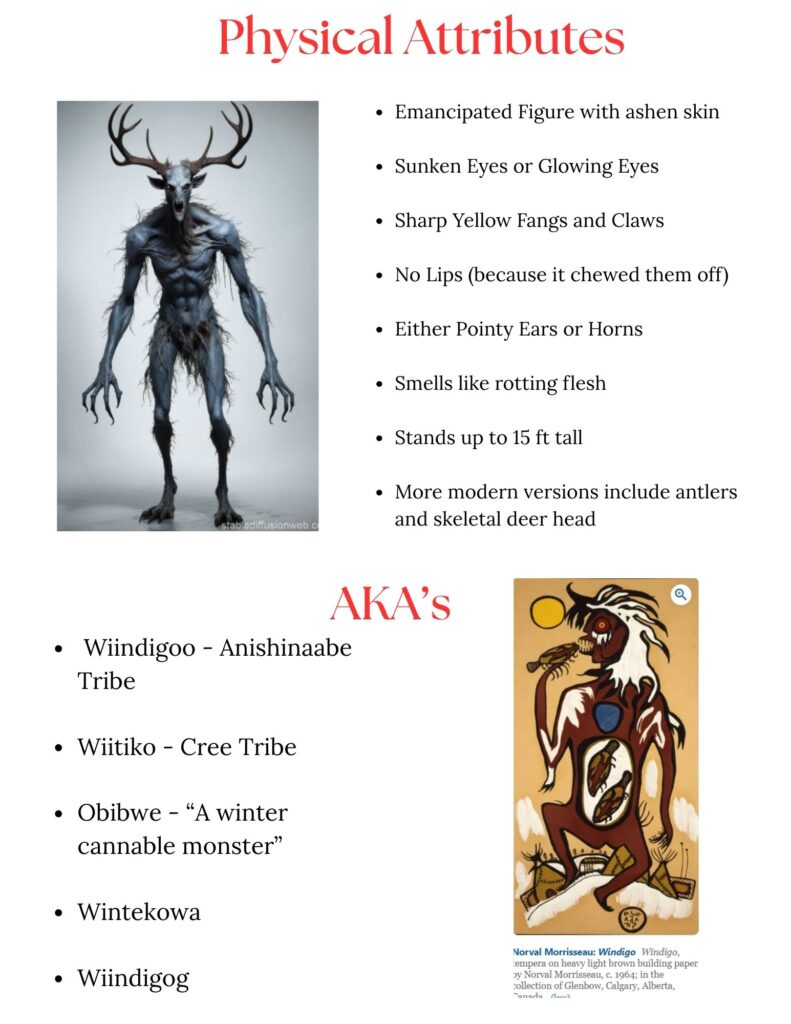
When a human crosses a threshold of desperation, something within them changes. In the case of the Wendigo, anthropologists believe the legend began as a cautionary tale about the importance of community to guard against greed, selfishness, and isolation in harsh living conditions.
But this change isn’t about possession, as much as it is a warning. Whether a person suffers from hunger or starvation, they act in a wild manner that is no different than someone who is gluttonous and will stop at nothing to achieve everything they desire; but all desires have consequences.
Let’s look at the Wendigo from a different perspective.
From a general point of view, when one is possessed, they turn into something else, something foreign that others don’t recognize about that person any longer. They’ve changed and usually not for the better—at least not according to the community or culture.
When we don’t feel ourselves any longer, we often turn to spirit. This can come in the form of religion, or other forms of faith. In the case of the Wendigo, if one is possessed, they turn to a shaman, or a spiritualist, to help rid themselves of the unnatural change.
Cue the shaman. It’s said that only a shaman can subdue a Wendigo by using steel, silver, or an iron bullet or dagger. They can only truly vanquish a Wendigo, however, by cutting out its heart and burn or melt in fire.
The Wendigo in Literature


Since Wendigo’s symbolize a society’s insatiable hunger for more–more food, more money, more resources, more, more, more–how can you use this creature in your writing?
Here are some questions that may help you get those brain juices flowing.
1) How does your protagonist’s deep-rooted fear awaken the Wendigo?
2) Think about cause-and-effect trajectory…How will the Wendigo transform the protagonist? What are the emotional stakes?
3) Write an introduction scene about how the Wendigo is introduced to your readers
4) Write a closing scene of how the Wendigo is eradicated (or is it?)
Happy Writing,
-RADolence
* Not all images are not mine; therefore, I cannot take credit.